|
 About
Our Materials About
Our Materials
All of the wood (mostly teak, mahogany or rosewood) used to make
the Asian furniture we carry is either solid re-claimed wood or solid
wood harvested from certified plantation grown trees. The result is beautiful
Asian furniture pieces that don't leave an ugly scar on the earth. We
also do not use particle board, paper board, veneer or any other low quality
substitute. If an item says "mahogany" then it is made entirely
of mahogany and is not just stained "mahogany color".
-Reclaimed wood comes from sources such as old houses, bridges and
railroads that are torn down and sold in scraps. The wood is then treated
and re-finished, and reborn as furniture. Reclaimed wood not only saves trees
and utilizes waste but is actually stronger than new wood because aging naturally
decreases water content in wood. The result is wood that is far less likely
to warp, expand or contract making it a more durable and environmentally friendly
choice. Over harvesting of forests is big problem all over the world despite
the efforts of green organizations world wide. It is the responsibility of
consumers to ensure that the Asian furniture that they purchase is made of
environmentally sustainable materials such as reclaimed wood.
-We use Plantation grown teak to make some of our furniture
pieces which comes from plantations that are regulated by the Indonesian
government vs. harvested from virgin forests. These plantations continually
plant new trees and are not permitted to expand into new regions. Plantation
owners instead strive to maximize wood out put from their land by improving
farming methods. The result is high quality lumber without the continued
destruction of earths remaining forests.
About the Construction
 The
majority of our furniture is made with mortise and tenon joinery and without
the use of nails. Have you ever purchased a piece of furniture that begins
to loosen and wobble after a just few years? Take a look and you will
most likely find it was fastened with nails. Through use nails begin to
pull from boards and quickly become looser and looser, and are difficult
to repair. Screws on the other hand, when fastened securely into sturdy
wood, will stay in place far longer and can be re tightened if needed. The
majority of our furniture is made with mortise and tenon joinery and without
the use of nails. Have you ever purchased a piece of furniture that begins
to loosen and wobble after a just few years? Take a look and you will
most likely find it was fastened with nails. Through use nails begin to
pull from boards and quickly become looser and looser, and are difficult
to repair. Screws on the other hand, when fastened securely into sturdy
wood, will stay in place far longer and can be re tightened if needed.
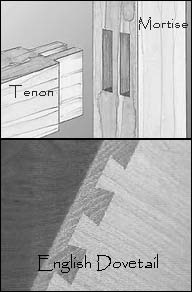
-Mortise and tenon joinery are among the strongest joints in furniture
making. There are two basic parts, the mortise, which is a recessed cut, and
the tenon, which is basically a corresponding sized peg which is a solid extension
of a board. Fit them together and fasten with a screw or an additional peg
and you've just made furniture that will last for generations.
-English dovetail drawers are not only sturdiest construction
technique but allow for more storage than commonly used french dovetail
drawers English dovetail drawers are a form of tenon joinery recognizable
by interlocking triangle pattern shown to the right. Most cheaper furniture
will use French dovetail construction which is not as solid
or space efficient.
For details about the construction of an individual piece found on
our site please contact our staff at 866-878-3325.
Warning! Just Because The Labels Says So Does Not Mean It Is!
Unlike the food and clothing industry, the furniture industry does not
have regulations over labels and advertisements. Furniture labeled as
"Brown Oak" may only have a "Brown Oak" colored stain
and actually be made of veneer and particle board vs. real Oak. Another
tricky labeling tactic commonly used is "solid wood construction"
which implies that the furniture is made of solid wood. Instead what that
really means is that the furniture is "solidly constructed"
of "wood", which may mean particle board. To ensure you get
what you pay for, It is important to find out what a piece of furniture
is truly constructed of before you make a purchase. Learn more by clicking
on the NBC News Logo below.

Click for Story
|